The idea: steer a little, every tick
A game character or a simulated bird should not jump to its goal. It should turn and speed up the way a vehicle does. Craig Reynolds' steering behaviours do this with one rule. Each tick, a behaviour says which velocity the agent would like to have, the desired velocity. The steering force is the difference:
steering = desired − v        (clamped to the max force)
v ← v + steering·dt          (clamped to the max speed)
p ← p + v·dt
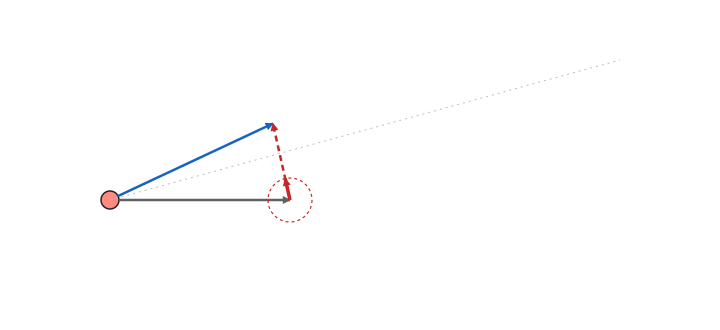
The max force is what makes the motion look natural. In Demo 1: one seek step up close, the boid flies right with v = (2, 0) and the target is down and to the right. desired − v = (−0.19, −0.85) has length 0.87, but only 0.1 of it is used: steering = (−0.022, −0.098). The boid turns a few degrees per tick.
The page uses a fixed timestep, dt = 1 tick, and seeded start positions. The same start gives the same flight every time, which is why the numbers below can be checked. See The Game Loop: Variable Delta Time vs a Fixed Timestep for why games step physics with a fixed dt, and Projectile Motion for motion under one constant force, gravity.
Seek and arrive
Seek wants full speed straight at the target. It never wants to slow down, so the boid flies past, turns and comes back. (Demo 2: seek overshoots and circles: start (15, 60), target (100, 20), max speed 2, max force 0.1. The boid first comes within 2 units at tick 47; at tick 100 it is 17.00 units away again. It circles the target for ever.)
Arrive is seek with brakes. Inside a slowing radius (20 units here) the desired speed falls in proportion to the distance, so it is 0 at the target.
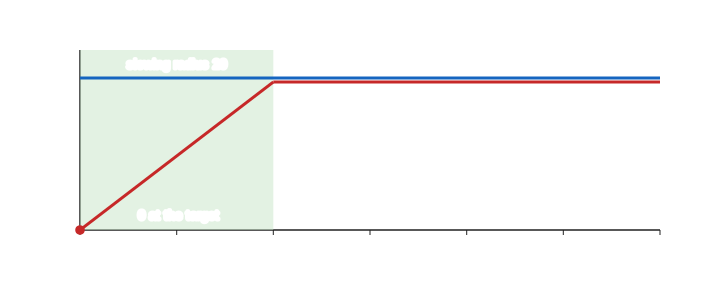
(Demo 3: arrive slows down and stops: the same start; at tick 100 the boid is 0.00 from the target at speed 0.00.)
Flee and adding behaviours together
Flee is seek turned around: the desired velocity points straight away from a threat. Here it only acts inside a panic radius of 15. Behaviours combine as a weighted sum of their steering forces, each clamped first. In Demo 4: arrive + flee steers around a threat, the threat sits next to the straight path and flee has weight 3. The boid swerves and comes no closer than 7.12 units (plain arrive would pass 2.43 from it). Once it is out of the panic radius, arrive takes it to the target: 0.02 units away at tick 120.
A weighted sum has a known weakness. If the threat sat exactly on the path, the two forces would point in opposite directions and could cancel, leaving the boid stuck in front of the threat.
Boids: three local rules
In 1987 Reynolds made a flock of boids ("bird-oids") from three steering behaviours. Each boid only sees its neighbours, the boids within a radius R (15 units here). Nobody leads and nobody knows the whole flock.
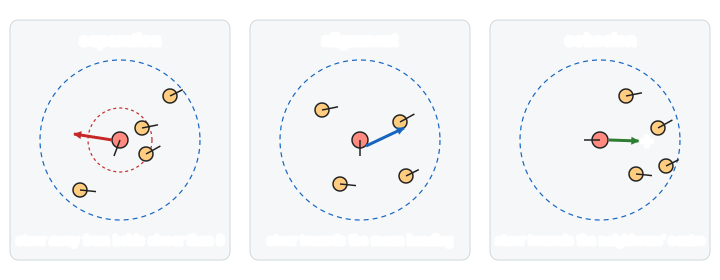
| Rule | Desired velocity | Weight here |
|---|---|---|
| Separation | away from neighbours closer than 6, each weighted by 1/distance | 1.5 |
| Alignment | the neighbours' mean velocity | 1 |
| Cohesion | seek the neighbours' centre | 1 |
Each rule's steering is desired − v at full speed 2, clamped to 0.05, then multiplied by its weight. All 24 boids work out their forces from the old positions, then all move at once. The world wraps around its edges. (Demo 5: one flocking step up close: the red boid has 6 neighbours, 2 of them closer than 6. Separation (−0.069, −0.030), alignment (−0.036, −0.035) and cohesion (0.013, −0.048) add up to (−0.092, −0.113).)
Measuring a flock
- The alignment order parameter φ = |mean of the unit velocities|. It is 1 when every boid flies the same way and near 0 when the headings are random.
- The closest pair: the smallest distance between two boids. Near 0 means boids sit on top of each other.
- Groups: link every two boids closer than R and count the connected parts.
(Demo 6: all three rules make a flock: φ goes from 0.26 to 0.94 in 100 ticks, the 13 starting groups merge into 2, and the closest pair stays 2.81 apart.)
What each weight does
Switch one rule off and the flock breaks in its own way. Same seed, 100 ticks:
| Weights (sep, ali, coh) | φ | closest pair | groups | what you see |
|---|---|---|---|---|
| 1.5, 1, 1 | 0.94 | 2.81 | 2 | a flock (Demo 6) |
| 0, 1, 1 | 0.99 | 0.13 | 2 | boids pile on top of each other (Demo 7) |
| 1.5, 0, 1 | 0.22 | 1.53 | 4 | clusters that mill about, no common heading (Demo 8) |
| 1.5, 1, 0 | 0.98 | 5.56 | 3 | aligned but loose; groups never join |
| 1.5, 0, 0 | 0.19 | 6.28 | 14 | boids only keep apart |
Boids look a little like particle swarm optimization, but the goal is different. PSO particles all listen to one shared best point to search a function. Boids have no goal and no shared memory; the flock comes only from what each boid sees nearby.
What the page leaves out
Real games and films use more behaviours (wander, pursue and evade a moving target, path following, obstacle avoidance with look-ahead, leader following) and pick between them by priority, not only a weighted sum. Boids there usually have a field of view, so they ignore boids behind them, and they work in 3D. With thousands of boids the neighbour search uses a grid or a tree instead of checking every pair. The page also skips mass (force = mass × acceleration) and orientation smoothing.