The idea: a counter of permits
A semaphore is a counter that never goes below 0, plus a queue of sleeping threads. It has two operations (Dijkstra's P and V):
sem_wait(&s): if the value is above 0, take one (value−−) and go on. If it is 0, sleep until someone posts.sem_post(&s): if a thread sleeps, wake it and give it the permit. Otherwise add one (value++).
The value is the number of permits left. Unlike a mutex, which lets exactly one thread in, a semaphore that starts at N lets up to N threads in. A semaphore that starts at 0 is a signal from one thread to another.
How to use the animation
Each thread has its own CPU. Pick a scenario tab, then Step Tick or Run to End. The box under SHARED MEMORY is the semaphore's value. A thread that has to wait goes to sleep in the kernel's wait queue and its CPU turns grey (free). The strip at the bottom shows every CPU's ticks.
A pool of N
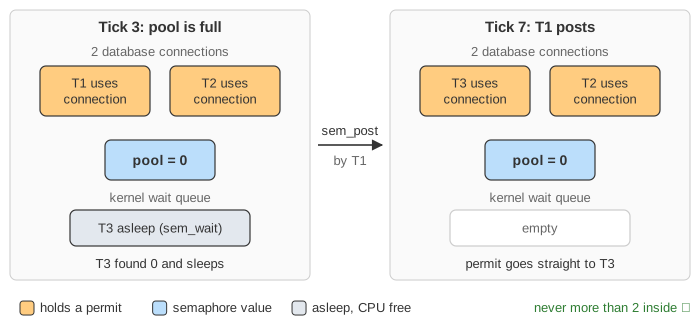
A program has 2 database connections and more threads that want one. sem_init(&pool, 0, 2) creates a semaphore with 2 permits. In Pool of 2 T1 and T2 take the two permits at tick 2 (2 → 1 → 0). T3 asks at tick 3, finds 0 and sleeps. At tick 7 T1 posts: T3 is asleep, so the permit goes straight to T3 and the value stays 0. Never more than 2 threads use the pool.
sem_wait(&pool);        /* take a permit, or sleep */
use_connection();
sem_post(&pool);        /* give it back, or wake a sleeper */
A signal between threads
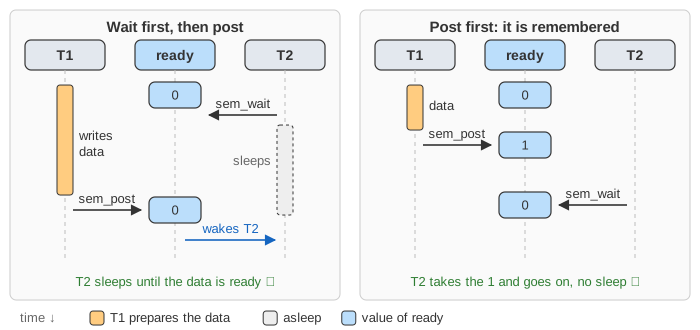
A semaphore that starts at 0 makes one thread wait for another. In Signal: wait, then post T2 needs data that T1 is still preparing. T2's sem_wait(&ready) finds 0 and sleeps; when T1 has written the data it calls sem_post(&ready), which wakes T2.
In Post first is remembered T1 posts before T2 waits. Nobody sleeps, so the value goes up to 1. When T2 calls sem_wait later it takes that 1 and goes on at once, with no system call at all. A condition variable has no such memory: a signal with nobody waiting is lost, which is why it is always used with a flag and a mutex (see Bounded Buffer).
No owner
A mutex belongs to the thread that locked it, and only that thread may unlock it (an error-checking mutex returns EPERM otherwise). A semaphore has no owner: any thread may post, and that is exactly what makes signalling possible. The price is that a mistake goes unnoticed. In No owner: stray post T4 calls sem_post(&pool) without ever waiting. The value becomes 1 while the pool is full, T3 walks in, and 3 threads use 2 connections ✗. The extra permit never goes away: the run ends with the value at 3.
| Mutex | Semaphore | |
|---|---|---|
| Threads inside | 1 | up to the initial value |
| Owner | yes, only the owner unlocks | no, anyone posts |
| Remembers a release with nobody waiting | it is simply free | yes, the value goes up |
| Typical use | protect shared data | limit to N, signal an event, count items |
Where you meet it
- POSIX:
sem_init/sem_wait/sem_post(unnamed, in memory, futex-based on Linux) andsem_open(named, shared between processes). System V:semget/semop. - Java:
java.util.concurrent.Semaphorewithacquire()/release(); C++20:std::counting_semaphore. - Linux kernel:
struct semaphorewithdown()/up(). - Classic problems: Bounded Buffer uses three semaphores (empty, full, mutex), Readers–Writers and Dining Philosophers too.
What the page leaves out
- How glibc does it: the value lives in user memory, and
sem_waittakes a permit with an atomic instruction, callingfutex_waitonly at 0, like the mutex. Here a post hands the permit straight to a sleeper; in glibc the woken thread takes it again itself. sem_trywait(fails withEAGAINinstead of sleeping) andsem_timedwait.- Fairness: which sleeper is woken first, and threads that arrive just as a permit is posted.
- Real timing: a system call and a context switch cost far more than one tick.