The idea: a throw leaves frames until a catch matches
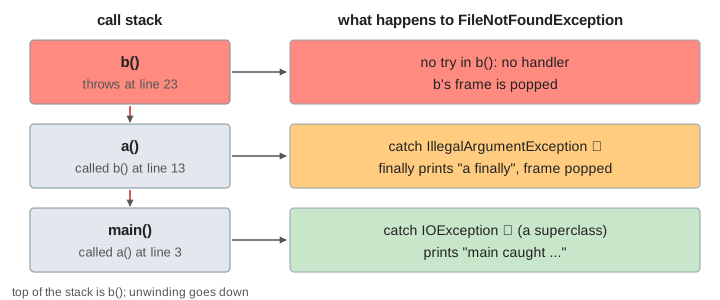
Every method call pushes a frame on the thread's call stack, and a normal return
pops it. A throw is a third way to leave code. The exception object is made, and the
JVM looks for a handler: first in the method that threw, then in its caller, then in the
caller's caller. Each method that has no matching handler ends at once and its frame is popped.
This is called stack unwinding. On the way out, every finally block
that the exception passes through still runs.
How to read the page
- Source: the Java program with its line numbers. Yellow is the line that
runs, blue is a
catchbeing tested, red is where an exception is thrown or arrives. - Call stack: one box per frame,
mainat the bottom. Each frame shows its current line, its locals and a pending completion while afinallyruns. A red box is an exception in flight, orange is a caught exception bound toe, blue is a return value on its way to the caller. - Console: what
System.outprinted, and in red whatSystem.errprinted. The exit status shows at the end.
The page's programs were compiled and run with a real JDK; the console shows the same lines.
How a catch is chosen
A try block marks a range of lines. When an exception comes out of that range, the
catch clauses are tested in order, top to bottom. The first one
whose type is the exception's class, or a superclass of it, runs. The rest are skipped.
| Line 23 of b() | Catch in a() | Catch in main() | Console |
|---|---|---|---|
| throw FileNotFoundException | IllegalArgumentException ✗ | IOException ✓ (a superclass) | b runs, a finally, main caught …, main finally |
| throw IllegalArgumentException | IllegalArgumentException ✓ | not reached | b runs, a caught …, a finally, a: after try, main: a returned, main finally |
| int z = 10 / 0 | ✗ | ✗ | b runs, a finally, main finally, then the stack trace; exit status 1 |
Notice that a: after try only prints when a handled the exception
itself. When the exception passes through, the rest of a never runs.
(Demo: FileNotFoundException, caught two frames up, Demo: IllegalArgumentException,
caught in a())
Because the order matters, Java refuses a catch (IOException e) placed before a
catch (FileNotFoundException e) in the same try: the second could never run, and
the compiler reports it as an error.
finally runs on every way out
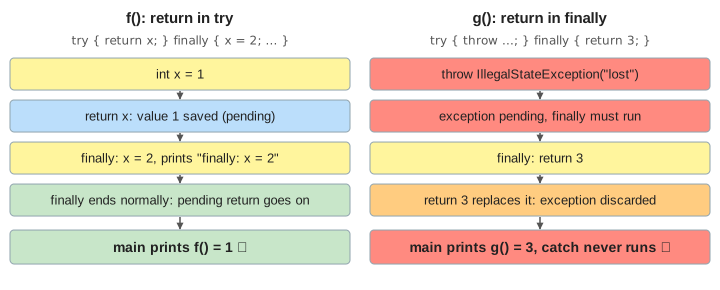
A finally block runs when the try is left normally, by return, or by an
exception. While it runs, the earlier way out waits. The page shows it as pending in the
frame. Two rules follow from this:
- The return value is saved first. In
f(),return xcomputes 1 and saves it. The finally block then setsx = 2, butf()still returns 1. The console showsfinally: x = 2and thenf() = 1. (Demo: return in try, finally runs first) - A return in finally wins. In
g(), the try throwsIllegalStateException. The finally block saysreturn 3, which replaces the pending throw. The exception is lost:main's catch never runs and the console showsg() = 3. (Demo: return in finally discards the exception)
A throw inside finally replaces the pending completion in the same way. That is why style guides
say: never return or throw from a finally block. javac -Xlint:finally warns about it.
Catch, wrap and rethrow
A catch block can throw too. A plain throw e; sends the same object on up the stack.
Often a method wraps it instead: load() catches the
FileNotFoundException from read() and throws
new UncheckedIOException("load failed", e). The old exception becomes the new one's
cause, so nothing is lost: main prints
cause: java.io.FileNotFoundException: cfg.txt. (Demo: catch, wrap and rethrow)
Checked and unchecked exceptions
Java splits exceptions in two. A checked exception (IOException and
its subclasses, and other Exceptions that are not RuntimeExceptions)
must be caught or declared with throws. That is why b() and
read() say throws IOException. An unchecked exception
(RuntimeException and its subclasses, and Error) needs no declaration.
This is a compile-time rule only. At run time both kinds unwind the stack in exactly the same way.
Wrapping a checked exception in an unchecked one, as load() does, lets it pass
through methods that do not declare it.
try-with-resources
try (Res a = new Res("A"); Res b = new Res("B")) { … } closes every resource that was
opened, in reverse order, when the block ends, however it ends. The closes run
before any catch or finally of the same statement. If the body threw and a
close() throws too, the second exception does not replace the first. It is added to
the first one's suppressed list (getSuppressed()). The console shows
close B, close A, then caught java.io.IOException: body and
suppressed: java.lang.IllegalStateException: close B.
(Demo: try-with-resources closes B, then A)
An uncaught exception
If no frame catches it, the exception leaves main too. The thread's
default uncaught exception handler prints the exception and its stack trace to
System.err, and the thread ends. When it is the last non-daemon thread, the JVM exits
with status 1. The trace was recorded when the exception was made, so it still names
b, a and main with their lines, even though those frames
are gone. All the finally blocks on the way ran first. (Demo: 10 / 0 is never caught)
Exception in thread "main" java.lang.ArithmeticException: / by zero
    at Main.b(Main.java:23)
    at Main.a(Main.java:13)
    at Main.main(Main.java:3)
How the JVM finds the handler
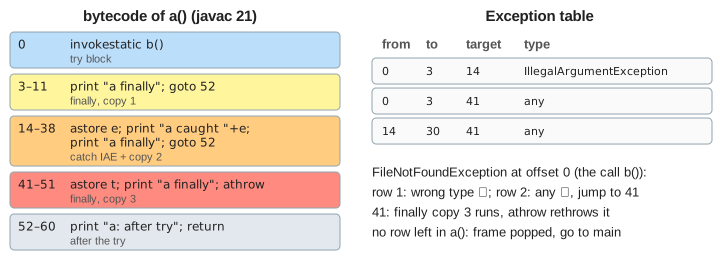
The compiler does not insert checks after every call. It writes an exception table
for each method: rows of from, to, target and type. When an
exception happens at a bytecode offset, the JVM scans the table for the first row whose range
holds that offset and whose type matches. If none does, the frame is popped and the scan repeats
in the caller at the offset of the call. A finally block is copied onto each normal
exit, and an extra row of type any covers the exceptional exit. Running code that does not
throw costs nothing extra.
Side note: C++ destructors and RAII
C++ has try, throw and catch but no finally.
Instead, during unwinding the destructor of every local object in each popped
frame runs, in reverse order of construction. Tying a resource to an object's lifetime is called
RAII (resource acquisition is initialization). It plays the role that
try-with-resources plays in Java:
void a() {
    std::lock_guard<std::mutex> g(m);   // locks m
    std::ifstream in("data.txt");          // opens the file
    b();                                   // b throws
}   // unwinding: ~ifstream closes the file, then ~lock_guard unlocks m
A destructor must not throw while another exception is unwinding the stack. If it does, C++ calls
std::terminate and the program stops. Java's suppressed list is the gentler answer to
the same problem. If no handler exists at all, C++ calls std::terminate too, and
whether the stack is unwound first is left to the implementation.
See also Recursion to an explicit stack and Heap vs stack in Java for how frames are pushed and popped, Exceptions in the MIPS processor for hardware exceptions and interrupts (a different thing with the same name), and OWASP A10: Mishandling of exceptional conditions for what careless exception handling does to security.
What the page leaves out
The page runs one thread and shows frames as boxes, not the JVM's operand stacks. It leaves out
Errors such as StackOverflowError, multi-catch
(catch (A | B e)), the precise rethrow rule that lets throw e keep a
narrower type, exceptions thrown while a resource is being opened, exception chaining with
initCause, Thread.setDefaultUncaughtExceptionHandler, the cost of filling in
a stack trace, and how C++ compilers implement zero-cost unwinding with unwind tables (the
Itanium ABI). Other languages differ in details: Python has else on try, C# keeps
finally but forbids a return in it.