The idea: two places for data, two lifetimes
A C program keeps its data in two places. The stack holds the local variables of the
functions that are running right now. The heap holds blocks the program asked for with
malloc. They differ in one question: when does the memory go away?
A local goes away when its function returns. A heap block stays until someone calls free.
The page runs small C programs one line at a time on a model of x86-64 Linux with glibc (gcc -O0, ASLR off,
so the addresses are the ones gdb shows). The left column is the source. The middle column is the stack,
with high addresses at the top. The right column is the heap. A pointer is a line from the stack slot that
holds it to the block it points to.
The stack: frames, rsp and rbp
Each thread has its own stack. The main thread's stack starts near the top of the address space and grows
down. The register rsp points at its lowest used byte. A call works like this:
- The caller puts the arguments in registers (
rdi,rsi, … in the System V ABI). callpushes the return address: where to continue in the caller.- The callee's prologue pushes the caller's
rbpand setsrbp = rsp.rbpis the fixed base of the new frame: locals are atrbp-8,rbp-16, … sub rsp, Nreserves the space for all locals at once. N is rounded up sorspstays 16-byte aligned.
Returning is leave; ret: rsp and rbp move back and the CPU jumps to the return address.
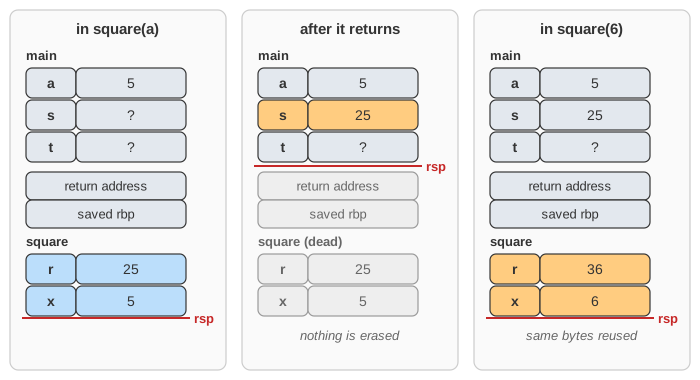
Nothing is erased. The old frame is just below rsp now (grey on the canvas), and the next call at
the same depth reuses the same addresses. That is why a new local that you do not initialise shows the
old value ("garbage"). Program 1 calls square twice: the second frame lands on exactly the same bytes.
The same frames on a simpler machine, instruction by instruction, with jal, jr $ra and the MIPS rules for preserved and nonpreserved registers: MIPS Procedure Calls.
Stack allocation costs one subtraction, and freeing costs nothing. The price is the lifetime: a local
cannot outlive its function, and the stack is small (8 MiB for the main thread by default, ulimit -s).
The heap: malloc is a library, not a system call
malloc is ordinary code in glibc. It gets big pieces of memory from the kernel now and then, and cuts
them into blocks, called chunks:
- A chunk is an 8-byte size field followed by the user's bytes.
mallocreturns the address 16 bytes after the chunk's start. The size is the request + 8, rounded up to 16, at least 32:malloc(16)andmalloc(24)both use a 0x20 chunk,malloc(100)a 0x70 chunk. The lowest bit of the size field,PREV_INUSE, says whether the chunk before it is in use, so0x21means "32 bytes, previous in use". - The first
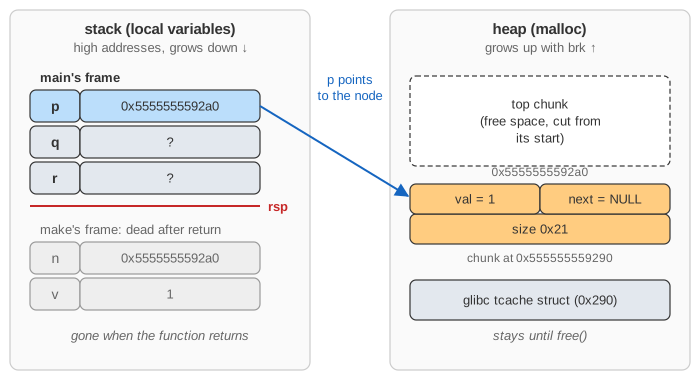
mallocin a process creates the heap: onebrksystem call moves the end of the data segment up by 132 KiB. glibc puts its owntcache_perthread_struct(0x290 bytes) first, which is why the first pointer you get is0x5555555592a0. The rest is the top chunk. - New chunks are cut from the start of the top chunk. When it runs out,
brkgrows the heap again, by the shortfall + 128 KiB (M_TOP_PAD). freeusually does not give memory back to the kernel. It puts the chunk in a bin so the nextmallocof that size can reuse it. The first stop is the tcache: one list per size, at most 7 chunks, last freed = first reused. Small chunks that do not fit in the tcache go to a fastbin. Larger ones go to the unsorted bin, merged with free neighbours or with the top chunk.- Requests of 128 KiB or more (
M_MMAP_THRESHOLD) skip the heap: each gets its ownmmap, andfreecallsmunmap. After such a free, glibc raises the threshold to that size (program 7).
A free chunk is reused for glibc's own bookkeeping. Its first 8 bytes become the fd pointer to the next free
chunk, stored as (address >> 12) ^ next (safe-linking, glibc 2.32+). A tcache chunk also gets a
key in its next 8 bytes. Program 2 builds a three-node list and frees it: watch p->next
get overwritten by the key, and the tcache list come out in reverse order.
A pointer is a value on the stack
struct node *p = make(1); puts two things in memory: 16 bytes on the heap (the node), and 8 bytes on
the stack (the variable p, holding the node's address). When make returns, its frame dies,
but the node lives on because main still has its address. Copying p copies the address, not the node.
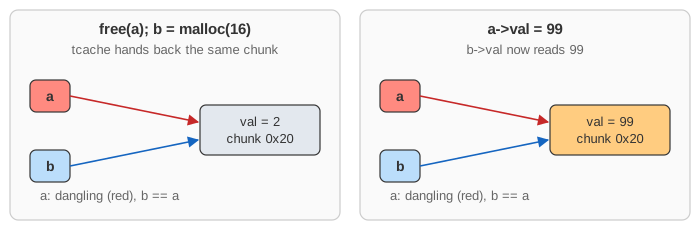
free(p) frees the node, but it does not change p. From then on p is a dangling
pointer: the canvas draws it red.
Stack vs heap
| Stack | Heap | |
|---|---|---|
| Who allocates | the compiler: sub rsp, N in the prologue | your code: malloc (glibc), sometimes brk/mmap |
| Who frees | the return (leave; ret) | your code: free |
| Lifetime | until the function returns | until free (or exit) |
| Cost | one instruction, no matter the size | tens of instructions on a tcache hit; a system call when the heap grows |
| Size limit | 8 MiB for the main thread (ulimit -s), often less for other threads | free address space and RAM (+ swap, overcommit) |
| Shared between threads | no, one stack per thread | yes, one heap (glibc uses several arenas to reduce lock contention) |
| Overhead per block | none, only alignment | 8-byte header, rounding to 16, minimum 32 |
| Fragmentation | none: always the top | free chunks between used ones |
| Running out | SIGSEGV (stack overflow) | malloc returns NULL (or the OOM killer) |
| Typical bug | returning &local, overflow | leak, use after free, double free |
The classic bugs, and why each one does what it does
- Returning the address of a local (program 4).
bad()returns&t. The first*pstill reads 7, because nothing has reused the dead frame yet. Thensquare(5)puts its frame at the same address,rlands ont's slot, and*preads 25. gcc warns (-Wreturn-local-addr). With optimisation on, it may even return NULL instead. - Use after free (program 3). After
free(a)the chunk is the head of tcache bin 0x20, so the nextmalloc(16)returns the same address:b == a. Writing through the old pointerasilently changesb's data. There is no crash, so the bug is hard to find. - Double free (program 6). The second
free(p)finds the tcache key in the chunk and the chunk in the bin. glibc printsfree(): double free detected in tcache 2and aborts. Older glibc had no such check: the chunk went into the list twice, and two latermallocs returned the same block. - Memory leak (program 5).
p = malloc(16)in a loop overwrites the only copy of the previous address. The old blocks are still "in use" but nothing reaches them. A leak checker walks the pointers from the stack (and globals) and reports what it cannot reach:definitely lost: 32 bytes in 2 blocks. - Stack overflow (program 8). Each
recurseframe holds a 1 MiB array. After 7 frames the 8th would reach below the 8 MiB limit. The kernel refuses to grow the stack and the process gets SIGSEGV. Program 9 asks for the same 8 MiB withmalloc: eightmmaps, no problem.
Tools that catch these: gcc -fsanitize=address (AddressSanitizer: use after free, stack use after return,
double free, overflows), valgrind --leak-check=full, and -Wall for the returned local address.
The playground
Pick a size and a variable, then press malloc, free or = NULL. Each press adds one line to a program and runs it. Things to try: free three 0x20 chunks and malloc 16 bytes again (LIFO reuse); free eight chunks of the same size (the 8th goes to a fastbin); malloc 1000, free it, and see it merge back into the top chunk; overwrite a pointer and press Leak Check; free the same variable twice.
See also: Stack vs Heap in Java (the same questions with references and a garbage
collector), How Linux Loads a Program (where the stack and brk come from),
Linux Virtual Memory (both are just mappings, filled by page faults),
The Buddy Allocator (where the kernel's pages come from) and
Linux Context Switch (each thread's rsp is saved and restored).
What the page leaves out
ASLR (every run would move the stack, heap and mmap addresses). Optimised code: at -O2 locals live in
registers, frames often have no rbp, and leaf functions use the 128-byte red zone below
rsp without moving it. Stack canaries (-fstack-protector), alloca and variable-length arrays.
Several threads: each gets its own stack (pthread default 8 MiB, mapped with mmap) and glibc gives
busy threads their own arenas. The small, large and sorted bins, the fastbin consolidation of big frees, and tcache
refills from fastbins. Other allocators (jemalloc, tcmalloc, mimalloc) make different choices.