The idea: every field starts at a multiple of its alignment
A struct is a block of bytes. The compiler gives each field an offset from the start of
the block, in the order you wrote the fields. But it can't always put a field right after the one before. Each type has
an alignment: an int must start at an address that is a multiple of 4, a
double at a multiple of 8. When the next free offset is not a multiple, the compiler skips bytes. Those
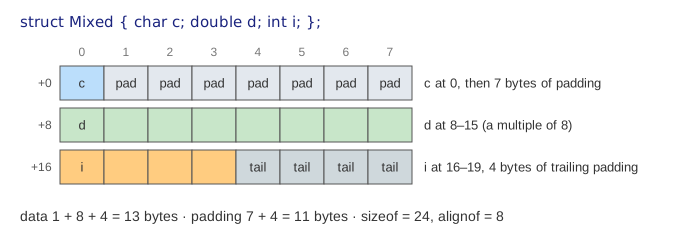
unused bytes are padding. So struct Mixed { char c; double d; int i; } holds 13 bytes of
data but takes 24 (Demo: char, double, int → 24 bytes).
Size and alignment of each type
On the usual 64-bit systems (Linux and macOS on x86-64 and arm64, the LP64 model) a basic type is aligned to its own size:
| Type | Size (bytes) | Alignment |
|---|---|---|
char | 1 | 1 |
short | 2 | 2 |
int, float | 4 | 4 |
long, double, any pointer | 8 | 8 |
a struct | its sizeof | the largest alignment of its fields |
The CPU loads an aligned value in one access, and it never crosses a cache line. That is why the ABI asks for it.
On 32-bit x86 Linux a double inside a struct is aligned to 4 only, and Windows has long = 4
bytes, so the numbers on this page are for LP64.
The rule: round the cursor up
The compiler keeps an offset cursor that starts at 0. For each field, in order:
- Round the cursor up to the field's alignment. The bytes skipped are padding.
- Put the field there, and move the cursor past it.
After the last field, round the cursor up once more, to the struct's own alignment (its largest field alignment).
That is sizeof, and the bytes added are trailing padding. For
struct Small { char c; int i; char d; }: c at 0, round 1 up to 4, i at 4–7,
d at 8, end at 9, round up to 12 (Demo: char, int, char → 12 bytes). Half of the 12 bytes are
padding. The C standard lets padding go after any field, never before the first one, so the struct's address is
always the address of its first field.
Why arrays need trailing padding
In struct Mixed arr[2] the elements sit back to back, exactly sizeof apart. With the 4
trailing bytes, arr[1] starts at 24 and arr[1].d at 32, a multiple of 8. Without them
sizeof would be 20 and arr[1].d would land at 28, misaligned
(Demo: array of 2). This is why sizeof is always a multiple of the struct's alignment, and why
malloc(n * sizeof(struct Mixed)) gives an array whose every element is aligned. Pointer arithmetic
such as p + 1 steps by that same sizeof; C++ Pointers
animates that part.
Reorder the fields to shrink the struct
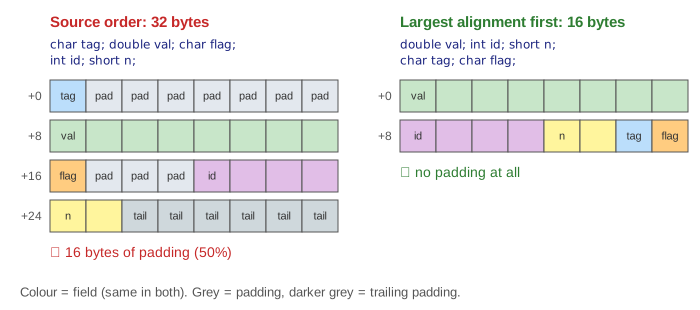
C never moves fields for you: the order you write is the order in memory. You can move them yourself. Put the
fields with the largest alignment first. Every size is a multiple of its own alignment, and every alignment is a power
of two, so after an 8-byte field the cursor is still a multiple of 4, 2 and 1. No gap is needed between the fields,
and only trailing padding can remain. Mixed goes from 24 to 16 bytes, and Record, with 5
fields, from 32 to 16 (Demo: sort the fields largest first, Demo: 5 fields, half padding).
Sorting can't remove trailing padding. struct Pixel { int x; int y; char color; } is already sorted
and still takes 12 bytes for 9 of data, because 12 is the next multiple of 4 (Demo: sorting can't remove trailing
padding). Saving 8 bytes per struct matters when there are millions of them: a smaller struct means more of them
per 64-byte cache line (see How a CPU Cache Finds, Misses and Replaces). Sometimes you keep a worse order on purpose, for
example to keep the fields used together in the same cache line, or to keep a file or network layout.
#pragma pack and what it costs
#pragma pack(1) (GCC and Clang also accept __attribute__((packed))) tells the compiler
to treat every alignment as 1. All padding goes: Mixed takes 13 bytes, exactly its data. But
d now sits at offset 1 and i at 9, and in an array arr[1].d lands at 14
(Demo: #pragma pack(1)). The costs:
- The compiler must emit loads that work at any address. On x86 they work but can be slower, especially when a value crosses a cache line. Some CPUs and some instructions (older ARM, atomics, SIMD aligned loads) fault on a misaligned address.
&s.dis adouble *that is not aligned. Passing it to code that expects a normaldouble *is undefined behaviour; GCC and Clang warn with-Waddress-of-packed-member.- Atomic operations on a misaligned field are very slow (on x86 a "split lock" that crosses a cache line stalls other cores) or fault outright on other CPUs.
Packing is for byte layouts fixed by someone else: file headers and network packets. Even there, many programs read the bytes into a normal struct field by field instead. Byte order inside each field is a separate question, shown on Little-endian vs big-endian.
Checking a layout yourself
| Tool | What it tells you |
|---|---|
sizeof(struct S) | total size, trailing padding included |
offsetof(struct S, f) (<stddef.h>) | offset of field f |
alignof(struct S) (C11 <stdalign.h>, C++11) | the struct's alignment |
_Static_assert(sizeof(struct S) == 16, "...") | fails the build if the layout changes |
gcc -Wpadded | a warning for each place padding is added |
pahole (dwarves) | prints every struct of a binary with its holes |
The numbers on this page were checked with sizeof, offsetof and alignof
compiled by Clang on arm64; x86-64 Linux gives the same.
Common mistakes
- "sizeof is the sum of the field sizes." Only with no padding.
Mixedsums to 13 and is 24. - "The compiler reorders fields to save space." Not in C, and not in C++ for fields with the same access. Rust does reorder.
- Comparing structs with
memcmp. Padding bytes hold whatever was there before, so two equal structs can compare unequal. Compare field by field. - Writing a struct to a file or socket as raw bytes. The padding (possibly old data from the stack or heap) goes out too, and another compiler or ABI may lay it out differently.
See also Stack vs heap in C for where a struct lives, C++ virtual functions: the vptr and the vtable for the hidden pointer a C++ class with virtual functions adds at offset 0, and MESI cache coherence and false sharing for fields of one struct fighting over a cache line.
What the page leaves out
Bit-fields, unions, flexible array members, nested structs (a nested struct is just a field with its own size and
alignment), alignas and over-aligned types, long double (16 bytes on x86-64 Linux),
32-bit and Windows ABIs, C++ classes with base classes or virtual functions, and empty structs (size 1 in C++). The
cost of a misaligned access is described, not measured.